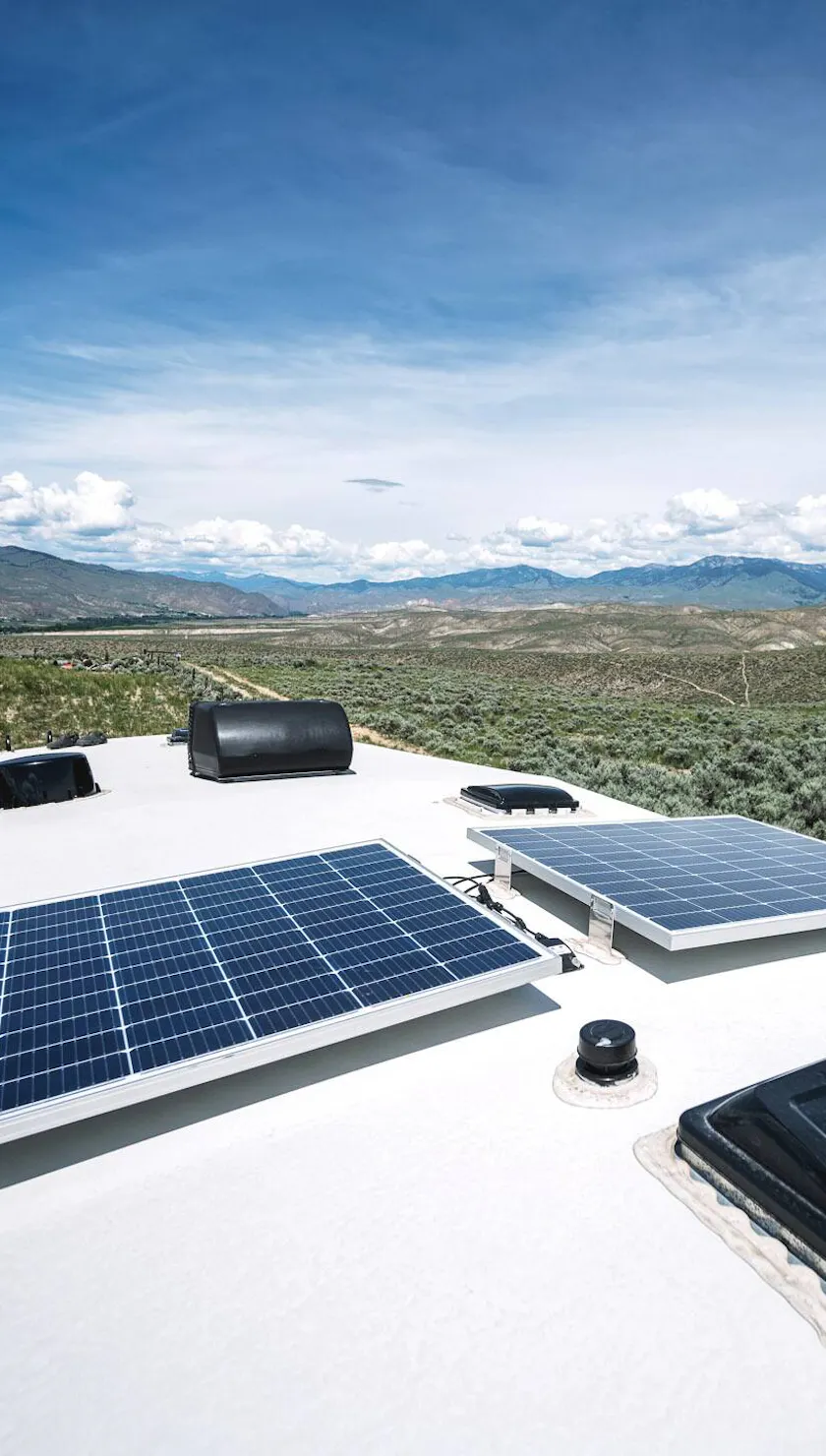
RV Solar Explained: What Your Solar Wattage Doesn’t Tell You
Seeing solar panels on an RV doesn’t tell you what the electrical system can actually do.
Solar wattage matters—but so do your batteries, inverter and how you use power.
RV Solar in 30 Seconds
Solar collects. Batteries store. An inverter converts.
- Solar Panels — Collect: Turn sunlight into electrical energy that helps replenish your batteries.
- Batteries — Store: Hold energy for your RV to use when you need it.
- Inverter — Converts: Converts stored battery power into 120-volt AC power for compatible equipment and circuits.
The takeaway: Look at the complete system, not just the solar wattage.
1. More Solar Doesn’t Automatically Mean More Usable Power
More panels can increase how much solar energy you collect, but they don’t automatically increase how much energy you can store or determine what equipment you can operate.
- Not collecting enough energy? Solar capacity or conditions may be limiting you.
- Running out of stored energy? Battery capacity or energy use may be the issue.
- Can't operate certain AC equipment? Look at the inverter and electrical configuration.
More solar and more battery capacity solve different problems.
2. Solar Doesn’t Mean Every Outlet Works Off-Grid
Many RV components use 12-volt DC battery power. Household-style outlets and other equipment use 120-volt AC power.
An inverter converts battery power into AC power for compatible equipment and circuits.
Instead of asking, “Does this RV have solar?” ask:
“Which outlets and equipment can I use from battery power when I'm not connected to shore power?”
That's a much better measure of what the system can do.
3. What You Want to Run Matters
Not everything in your RV uses the same amount or type of power.
Think about what you want to use away from shore power:
- Lights and USB charging
- Basic RV systems
- Household-style outlets
- Coffee maker or microwave
- Air conditioner
Higher-demand equipment can require substantially more from the batteries and inverter.
Start with what you want to use, then determine what system capability you need.
4. Can RV Solar Run the Air Conditioner?
Some properly equipped RV electrical systems may be able to operate an air conditioner from stored battery power.
But solar panels alone don't determine that capability.
What matters includes:
- Battery capacity
- Inverter capability
- Available solar production
- The air conditioner
- Other electrical loads
And remember:
Starting an air conditioner and running it for an extended period are two different things.
If off-grid AC matters to you, ask what the complete system is designed to support and what affects expected runtime.
5. Solar Wattage Isn't Guaranteed Output
A panel's wattage rating isn't a promise of constant production.
Actual output can change with:
- Available sunlight
- Clouds
- Shade
- Time of day
- Season
- Panel condition
At night, the panels aren't producing solar energy. Your RV uses energy already stored in the batteries.
Solar capability is partly about collection—and partly about managing what you use.
6. Before You Add More Solar, Find the Bottleneck
Want more off-grid capability? Don't automatically start with another panel.
Ask:
- Are my batteries replenishing enough during the day?
- Am I running out of stored energy too quickly?
- Is my inverter capable of supporting what I want to use?
- Am I simply using more energy than my system can replenish?
The answers help determine whether you should investigate solar collection, battery storage, inverter capability or your energy use.
7. What Should You Compare When Shopping for RV Solar?
Don't compare solar wattage alone.
Ask:
- How much solar collection is included?
- What battery type and capacity does the system support?
- Is an inverter included, optional or prepped for?
- Which outlets and equipment can operate from battery power?
- Can I monitor battery charge and energy use?
- Can the system be expanded?
These questions tell you more than a “solar equipped” label.
Understanding Keystone SolarFlex
Keystone SolarFlex integrates solar charging and related electrical components into compatible Keystone RVs, with different configurations designed for different power needs.
Depending on the specific SolarFlex system, equipment can include solar panels, charge controllers, inverter capability or preparation, monitoring and expansion options.
If you own or are shopping for a Keystone RV:
- Identify the SolarFlex system.
- Understand what that configuration is designed to support.
- Use Keystone's SolarFlex resources for system-specific guides, FAQs and compatible options.
The Better Question to Ask About RV Solar
Don't ask only:
“How many watts of solar does this RV have?”
Ask:
“What can this complete system do for the way I want to camp?”
The best RV solar setup isn't necessarily the one with the biggest number on the roof. It's the one with the collection, storage and capability that fit how you camp.